

Using AI Without Burning Out
Why creativity, calm, and nervous system regulation matter more than speed


We’ve all had this getting-to-know-AI moment: “Aha, so AI could do this? Wow”. A feeling that’s often a mix of excitement, overwhelm and a bit of anxiety. Today, we are diving in that feeling. What is the science behind that?
This article will give you practical advice to get durable skills to work with AI in a healthy way.
Hi, I’m Wilbert Kramer and I am co-writing this article with Jessica Drapluk from NP Fellow. I’m building a community of marketers and entrepreneurs in Decode: AI here on Substack, to learn and grow durable AI skills. My mission is to bring peace through expertise. I bring in over 15 years in international marketing and work in AI consultancy as a marketer.
Emotional wellbeing in the marketing profession was already an important topic. You can easily be overwhelmed. With AI, there is an extra layer to it, and it often comes with high demands. Jessica has been writing about emotional wellbeing and resilience for a long time and it’s great that we are starting to talk about the risks of AI overwhelm and how our nervous system regulation plays a part in that.
Hi, I’m Jessica Drapluk. I write NP Fellow, a mental health and functional medicine weekly publication about nervous system healing, emotional regulation skills, emotional resilience, and the simple science of slowing down enough to feel safe in your own body again. I help high-achieving professionals who want to strengthen their minds, build resilience, restore clarity, and prevent burnout.
My mission is to show people how to rewire their brains, lead others to live with purpose, and empower individuals to become the CEO of their own health.
I’ve spent ten years working in healthcare as a certified pediatric hematology oncology nurse and family nurse practitioner, where I’ve seen firsthand what happens when systems move faster than the humans inside them. Long before AI entered the conversation, burnout, overwhelm, and emotional depletion were already common especially in high-demand professions.
When AI arrived, it didn’t create pressure from scratch. It layered speed on top of an already overstimulated nervous system. That’s the lens I bring to this conversation: not whether AI is good or bad, but how our bodies and minds experience acceleration and what helps us stay grounded while using powerful tools.
A marketer’s journey with AI
Wilbert: The first time I really “felt” AI’s capabilities I noticed a weird combination of excitement and worry. AI felt like something too big to handle while at the same time the potential felt enormous.
That feeling grew on me when I started my job in AI consultancy. Firsthand, I saw AI agents being implemented and reducing 80 hours of work to a mere 30 minutes. What?!
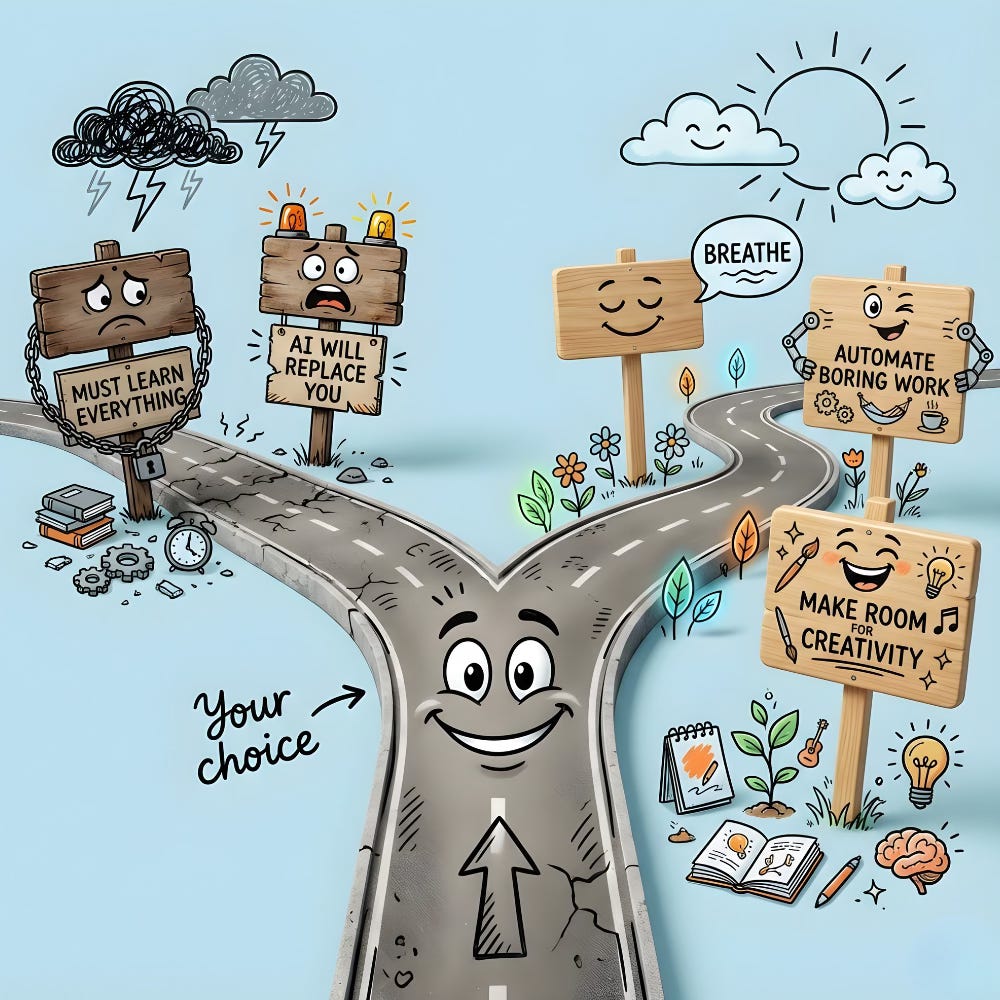
Creativity was at a crossroads. There was a need for speed and content creation was expected to have 10x the output.
While doing great work with support from AI, my mind spiraled into overload: AI first, layoffs, hyper intelligence, human in the loop, will it take over my job?
I felt an urge to keep up with AI closely.
I also felt I had a choice here:
Nervous system and creativity
Jessica: When I first started paying attention to AI’s capabilities, my reaction wasn’t fear of the technology itself, it was a familiar bodily response. Tightness and mental noise. A subtle urgency to keep up, even before I knew what “keeping up” meant. Clinically, this often shows up as shallow breathing, jaw tension, mental looping, or a sudden urgency to “optimize” everything at once even when nothing is actually wrong.
From a nervous system perspective, this makes complete sense. Our brains are wired to detect rapid change as a potential threat. When information, expectations, and pace increase all at once, the body doesn’t interpret that as opportunity, it interprets it as pressure.
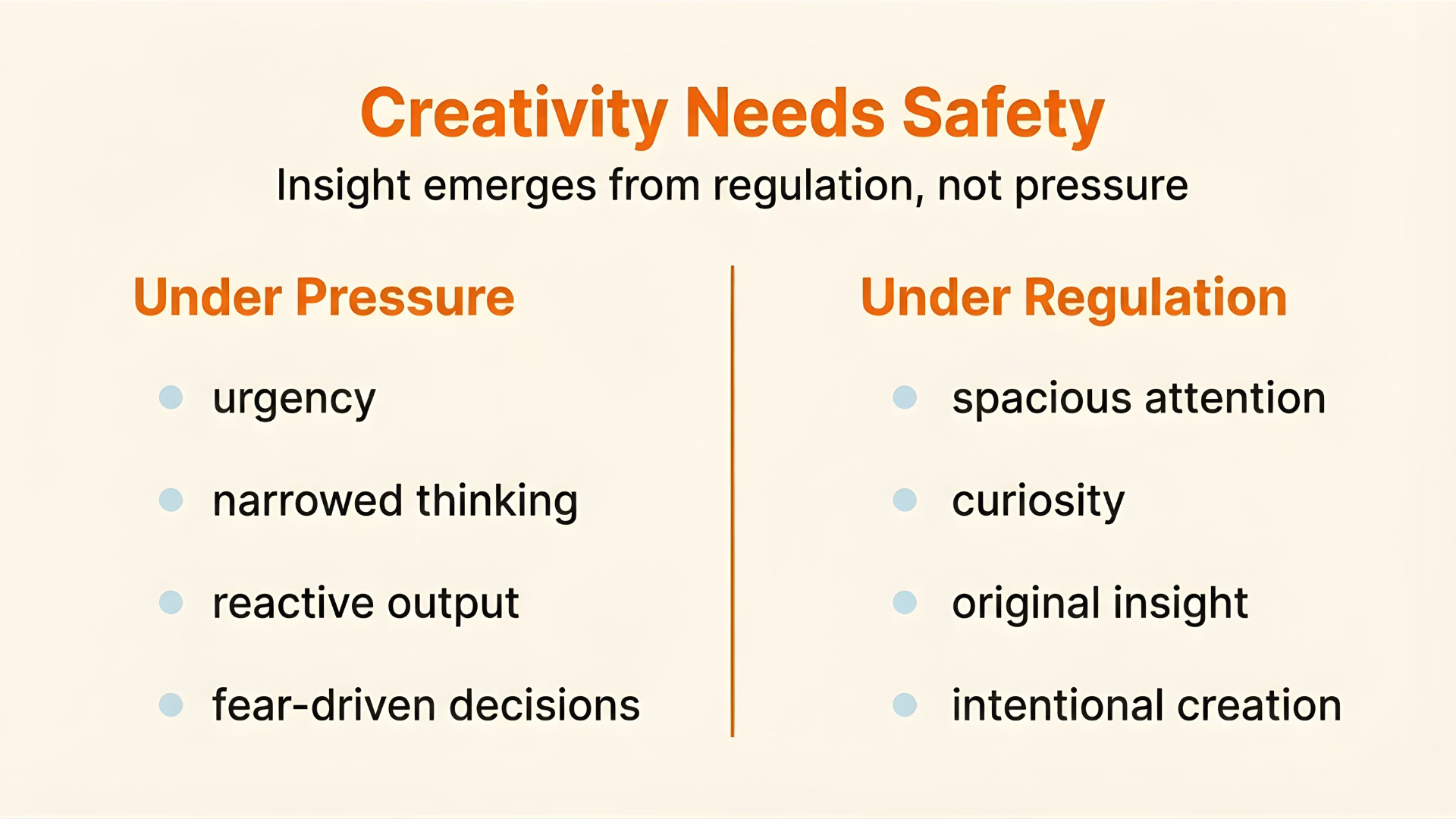
Those anxious, racing thoughts that show up around AI aren’t a sign of weakness or resistance. They’re a signal that the nervous system is overloaded. And when that happens, creativity doesn’t expand, it contracts. Curiosity narrows and decision-making becomes reactive instead of intentional.
What helps isn’t more information or more tools. What helps is restoring a sense of safety and capacity first. When the nervous system settles, clarity returns. And only then can AI become supportive instead of overwhelming.
Regulation as a necessary skill in the AI age
Wilbert: Can these feelings of overwhelm be explained and are they harmful? Can using AI (indirectly) lead to burnout?
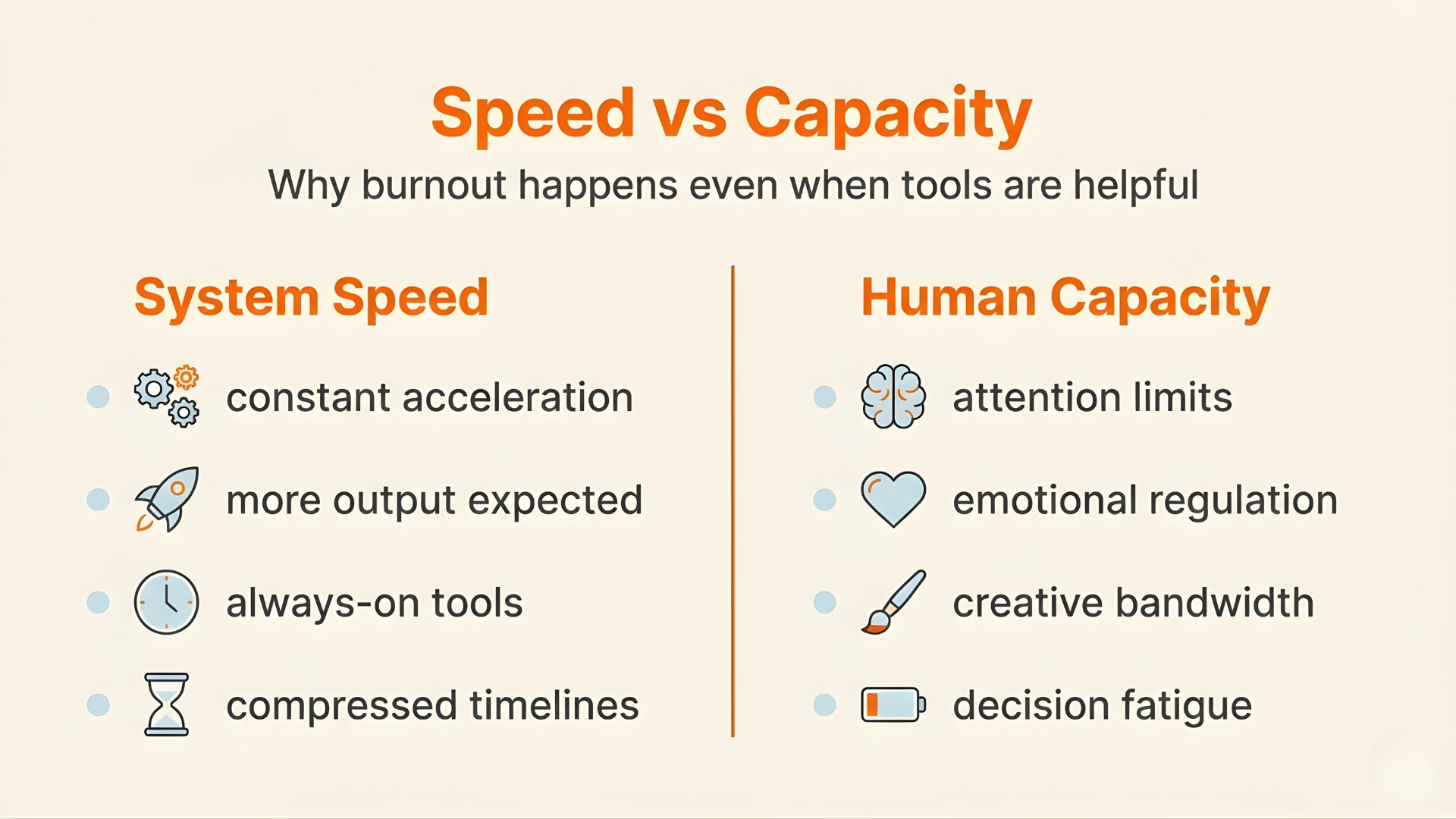
Jessica: Yes. These feelings are absolutely explainable. Chronic cognitive overload keeps the nervous system in a low-grade activated stress response. Over time, that state makes it harder to focus, harder to rest, and harder to feel creative or motivated. When speed becomes constant, burnout isn’t a personal failure, it’s a physiological outcome.
AI doesn’t cause burnout on its own, but when it accelerates workloads without restoring capacity, it can push already taxed systems past their limit. That’s why nervous system regulation isn’t a “wellness add-on” or a “mental health tip or hack.” It’s a real, foundational skill for sustainable work in the AI era that can be built with practice and repetition.
Staying grounded
The most durable skill in the Intelligence Era is not knowing every AI tool; it’s knowing how to stay grounded while using them. You have a choice to take a different stance on AI, a healthy one.
Let’s dive into how this could look:
AI will never take the place of your own creativity and edge.
There is an emotional satisfaction that comes from creativity, and we have to cherish it.
Wilbert: Creativity is bigger than intelligence. Intelligence is feeding creativity, not the other way around. You can also say “Creativity is the highest form of intelligence“. AI can’t replace the emotional satisfaction you are getting from creating things.
You don’t have to learn every single tool.
You don’t have to rush AI or read everything about it.
Wilbert: How we do work is changing, but most outcomes, services or goods, will remain. Start with looking at your own work and processes and look how AI can complement this. Then pick a tool. Pick one, two or three verified and trustworthy sources and follow creators that have great insights on AI.
Jessica: Pausing and reflection aren’t inefficiencies; they’re human superpowers. Even something as simple as a 10 to 30-second pause before opening a tool like feeling your feet on the floor, exhaling slowly can shift your nervous system out of urgency and back into choice.
When we slow down intentionally, we give the nervous system a chance to recalibrate. That’s when insight returns. That’s when creativity becomes playful again instead of pressured. Even brief pauses like stepping away from screens, taking a walk, or breathing without input help reset the brain’s ability to choose rather than react.
In a world that rewards speed, the ability to pause is a skill.
And like any skill, it gets stronger with practice.
AI is too big to tackle on your own.
It is up to organizations to take a clear stance on AI.
Wilbert: If you work for an organization: AI is teamwork, share your insights about it within your team. Organizations need to step up and clearly explain their stance and train people to work with AI. Also: if you implement it right professionally, it can make work more fun. And open up more room for creativity.
It’s also okay and often necessary to turn AI off
Jessica: Creativity doesn’t usually emerge while inputs are flying at us. It shows up in quiet moments, when there’s enough internal space to hear our own thoughts. Some of the most generative ideas don’t come from prompts or optimization; they come from stillness.
Sometimes the most supportive thing you can do is step away from technology entirely. Grab a notebook. Write by hand. Let ideas arrive without direction. Silence isn’t unproductive; it’s fertile.
Your nervous system may be the most important AI amplifier you have
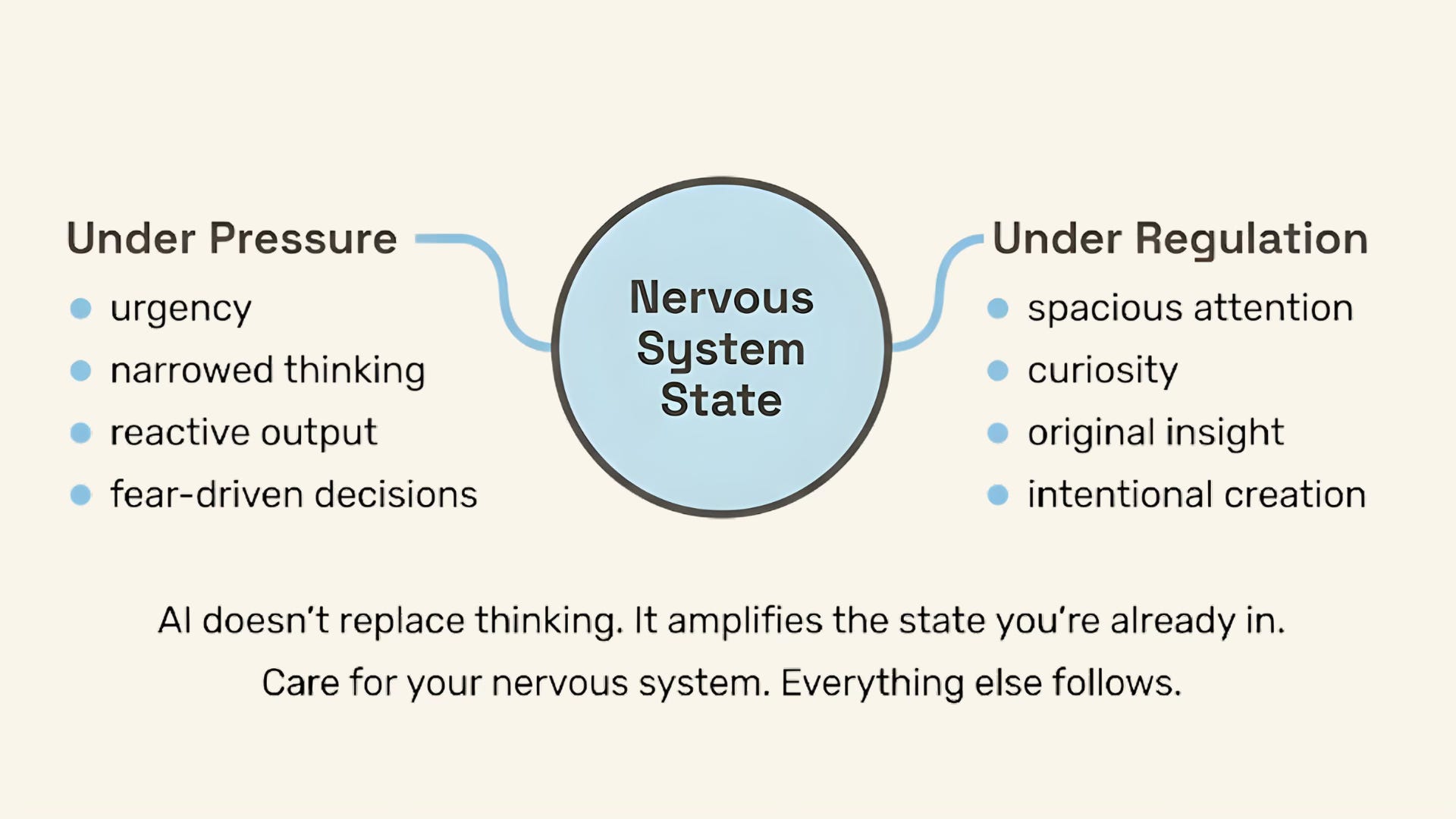
AI doesn’t take creativity away, but unchecked speed can. The real risk isn’t that machines will replace human thinking. It’s that people lose the conditions that allow them to think well in the first place.
Creativity, insight, and good judgment don’t emerge under constant pressure. They require pacing, safety, and the ability to step back. You don’t need to master every tool. You don’t need to be always on. And you don’t need to treat acceleration as a personal test of worth.
Choosing when to engage, when to slow down, and when to step away isn’t resistance, it’s skill. The future won’t belong to the fastest adopters. It will belong to those who can stay regulated, reflective, and intentional as systems evolve around them.
AI is a powerful tool.
Your nervous system is the limiter, or the amplifier.
How you care for it will shape everything that follows.
P.S. We are curious, are you deliberately slowing down on AI from time to time?
P.P.S. If you liked this article, consider subscribing:
 | A guest post by
|