

The AI Marketing Team Playbook
Part I: How I’m setting up marketing at the Netherlands’ largest social-cause fundraiser. Finding a Brand Voice and my first steps here.

I just started in a new job.
A type of job that has been on my list for a long time.
And lucky me, it happened: I landed the job at Netherlands’ largest social-cause fundraiser as the lead marketer.
My new role
When I stepped into this marketing role, the situation was familiar to anyone who’s joined a growing company:
Marketing existed, but it is scattered.
LinkedIn, a website here and there, a SaaS platform with high potential, Google Ads running, but no unified strategy, no brand voice, no content repurposing.
Just a great team doing their best at the serving the customer, social causes.
Please get me right: this is not criticism. It’s the reality for most organizations that are growing on the strength of the value the offering and word of mouth marketing.

A bit of context. About what we do:
The company is the Netherlands’ largest fundraiser for social causes. We help churches, monuments, hospices, community centers, and other social organizations navigate the maze of subsidy and grant programs.
That means: finding funding they’re entitled to but often don’t know exists, and handling the grant applications that would otherwise consume weeks of volunteer time.
Think about that for a moment.
A small church committee trying to make their building more environmental friendly and sustainable has to wade through subsidy programs, different criteria, different forms, different deadlines. We do that for them.
My Goals
The marketing stack, when I arrived, was straightforward. So, after onboarding, I defined my task here:
How do we build a proper marketing operation with a small team, a budget, and the ambition of a marketing team twice our size?
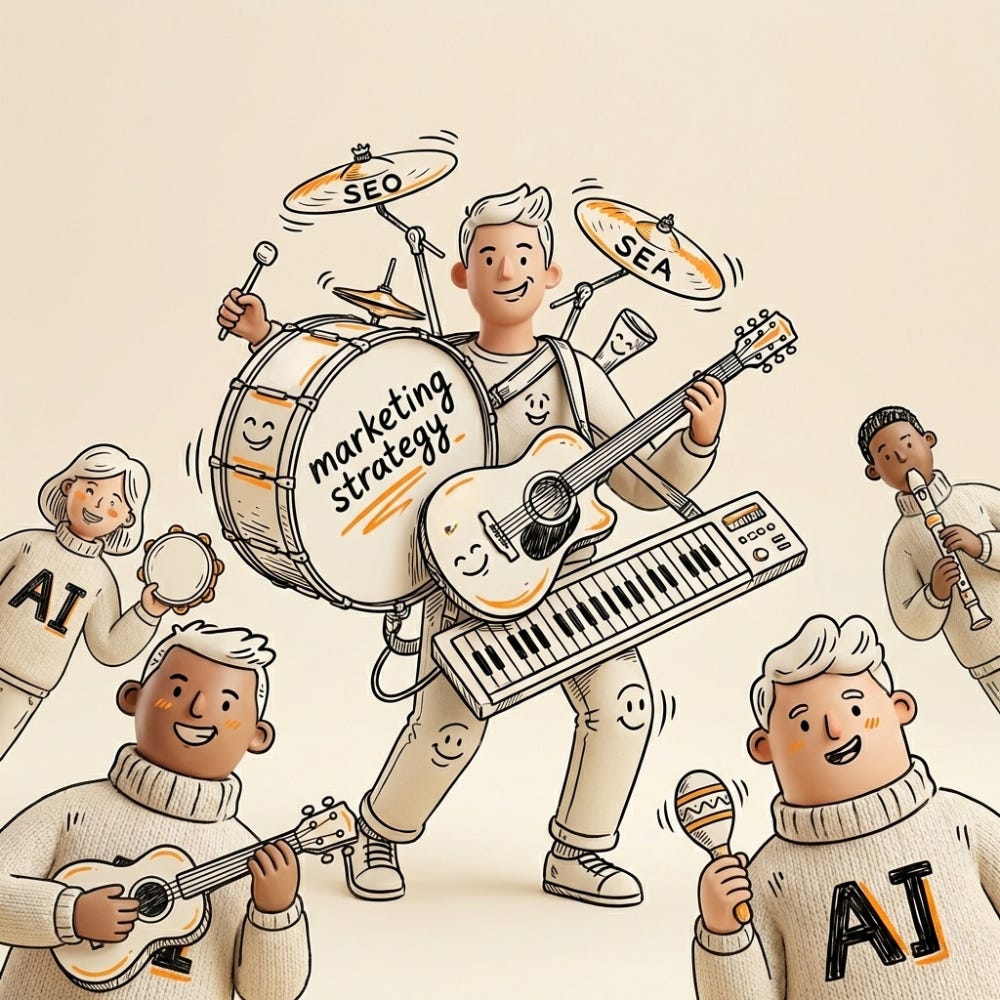
We are a marketing team of 3, and I work parttime at this job, but with AI we can operate at a larger scale.
So, Claude Team will be added to the mix. Yes!
Part 1: Onboarding
My first step: using notes effectively during onboarding.
When you start a new role, you are drinking from a firehose.
Every meeting and walkthrough contains gold. Context you won’t remember in three weeks but will desperately need anyway.
I used AI transcription or note taking for onboarding sessions and then had Claude process those structured notes and, often looked over: *the language people actually use when talking about the company.*
That last part matters more than you’d think.
The words colleagues naturally use to describe what the company is the raw material for your brand voice.
No amount of brainstorming will produce language that is as authentic as this and is direct input for your brand’s voice document.
Finding the Brand Voice Faster Than I Expected
This is where I’ll be honest about something that might sound contradictory coming from an anti-hype AI pragmatist: Claude Opus 4.6 genuinely accelerated the brand voice process.
Here’s what I mean.
Normally, defining a brand voice is a days-long process of workshops, interviews, writing samples, and iteration.
Documenting and drafting a first version was easier now with Claude.
What I did: I combined my own instincts (fifteen years in marketing will give you that) with everything I’d absorbed and recorded during onboarding.
Then I prompted Opus 4.6 to generate a first concept for a Brand Voice document.
Prompt:
Determine the brand voice for my brand. (Already fed the memory in Claude) All the sub brands involved are attached. Also I included meeting notes, transcriptions that you can use as further reference. For now, this is my conclusion after two weeks here:

- Professional and thorough approach
- Clear communication at the client level
- Very proactive, exploring all possibilities and celebrating successes
- Humor important in the process
- Correct and friendly
- Sharp and a touch innovative
- A touch unconventional
- Down to earth

Ask me a few questions first to further define the brand voice before proceeding
Model selected: ☑️ Claude Opus 4.6 Extended.
Context added: PDF (Miro board with subbrands and key communication goals per brand), all of my relevant meeting notes and transcripts.
(Now you also know a little bit about the company’s vibe. It’s great, I can say that.)
Wow! Back to Opus 4.6:
It asked the right questions. Like, 10 of them. All spot on and relevant.
I answered.
It gave me back a solid first draft.
The result wasn’t perfect. But it was directionally right in a way that would have taken me at least a day of solo work to make.
It captured the tension that makes it interesting: we’re professional and thorough. We handle serious money and complex regulations. But we are also warm and accessible, our clients are often volunteers, not corporate professionals. And yes, it correctly said: no jargon please.
This way, as a team, we can align on a brand voice really quickly.
Step 2: Building the Marketing Stack
So here’s how I’m thinking about the team structure. With 3 people, 6 brands and AI support, you need to be clear about what humans do versus what systems do.
The human work (non-negotiable):
Strategy decisions. Creative direction. Quality control. Input about tone, taste, timing of our posts. For example what the buildup in a LinkedIn video needs to be, who to interview.
The AI-augmented work:
Content drafting and repurposing. I will build a content repurposing system with Claude Code or maybe organize it in a Claude Project. SEO research and optimization suggestions. Ad copy suggestions. Script writing.
Using Zapier to automate and enhance with AI.
The mistake small teams make is trying to automate the AI-augmented work entirely. Don’t. Use AI critically.
For example: I still prefer to fully write LinkedIn-post by hand, and only with light AI assistance. You should do this too.

My AI Tool Stack

It’s not about the tools, but AI capability. But yes, you still want to know what I am using day to day in my work as a marketer. I get that.
The fully automated work:
There are certainly things to automate, but I am not there yet fully. I will think about more proactive AI solutions in the future here.
Conclusion (so far)
AI will not make your strategy.
You need to do the groundwork:
If you don’t know who you’re talking to, and know your customer, you will fail.
If your brand voice is confused, AI will generate bad content.
If you don’t have direction yet, you can’t steer AI in the right way.
What AI will do, when the strategy is clear and the team is skilled, is remove the friction. You will be faster execution-wise.
Three people with clear direction and smart AI support can…
…outperform a larger team that is using AI in a wrong way.
To be continued!
Ps. I hope this could be of inspiration to you. When is the last time you could build something from scratch with help of AI?
I love this, first of all congrats :) :)
I try to do the human/AI/automated split a bit differently - I map it per content type rather than per task category, because the same "drafting" task needs full human hands for some formats and almost none for others. Like, LinkedIn posts - 80% mine, email drafts - 99% AI haha.
But 6 brands is craaaaaazy!!
Very interesting approach Wilbert, I am curious to see how this will evolve…also, do your co workers enjoy it as well?
And, great input Mia!