

An AI-driven Brand Voice System: Why Every Brand Needs One
Step By Step Guide

Who is this for?
For anyone who understands that a brand has value and that its appearance and communication matter just as much.
For:
Marketers who want to align organizations around consistent communication
Influencers who struggle to post with a consistent voice
News platforms that want a recognizable and consistent voice
CEOs who want to build a focused and effective LinkedIn strategy
By the end of this article, you will have all the tools you need to build a Brand Voice System that saves you hours every week and ensures organization-wide consistency in communication.
A strong brand is recognizable by its logo, but people truly fall in love with it through its tone of voice, the brand’s voice. Think about the sheer volume of communication sent on behalf of your organization. Campaigns, thousands of customer service emails, and a single LinkedIn post from the CEO.
Communication is everything.
How do you want your brand to sound? “Tone of voice” is often left vague. Sometimes it is reduced to a few adjectives and that is it. A missed opportunity.
Because if you stand for nothing, you sound like everyone else.
Brands that make an impact do not optimize individual texts. They first build the foundation. A Brand Voice System. A practical guide that enables everyone in the organization to write effortlessly in the same voice.
With AI, this becomes even more powerful.
I have implemented such systems for multiple brands and spent the past year refining them. What works and what does not? And does such a system remain consistent as new models are released every week?
I have laid it all out here.
How to build this system and let AI do most of the work
Step 1. The foundation. Who are you and who are you not?
Start with the basics. Who are you, who do you serve, and what feeling do you want to leave behind? Translate this into a one-paragraph brand story. This often flows from your organizational goals and core message. This is your compass.
Next, choose three to four words that capture your personality. For example: pragmatic, smart, human. Just as powerful is the anti-definition. What are you definitely not?
Do: Pragmatic
Do: Human
Do not: Boring or blunt
Do not: Trendy or childish
This immediately creates a filter.
Anti-examples are especially powerful when working with an LLM. They remove ambiguity and give the model clearer direction.
Example brand story:
As a fundraising organization, we focus on higher-segment clients such as large healthcare organizations and cultural institutions. We work with a personal approach and a pragmatic, accessible way of working. Calm, reassurance, and strong control over the process are brand values we aim to project. By drawing from a carefully curated database of more than 7,000 funds, we often find the right match, resulting in a 95 percent success rate for grant applications.
Example brand personality:
Do: Pragmatic
Do: Human
Do: Accessible
Do not: Playful
Do not: Complicated
Action: save the brand story and brand personality in a single document titled Brand Voice (PDF).
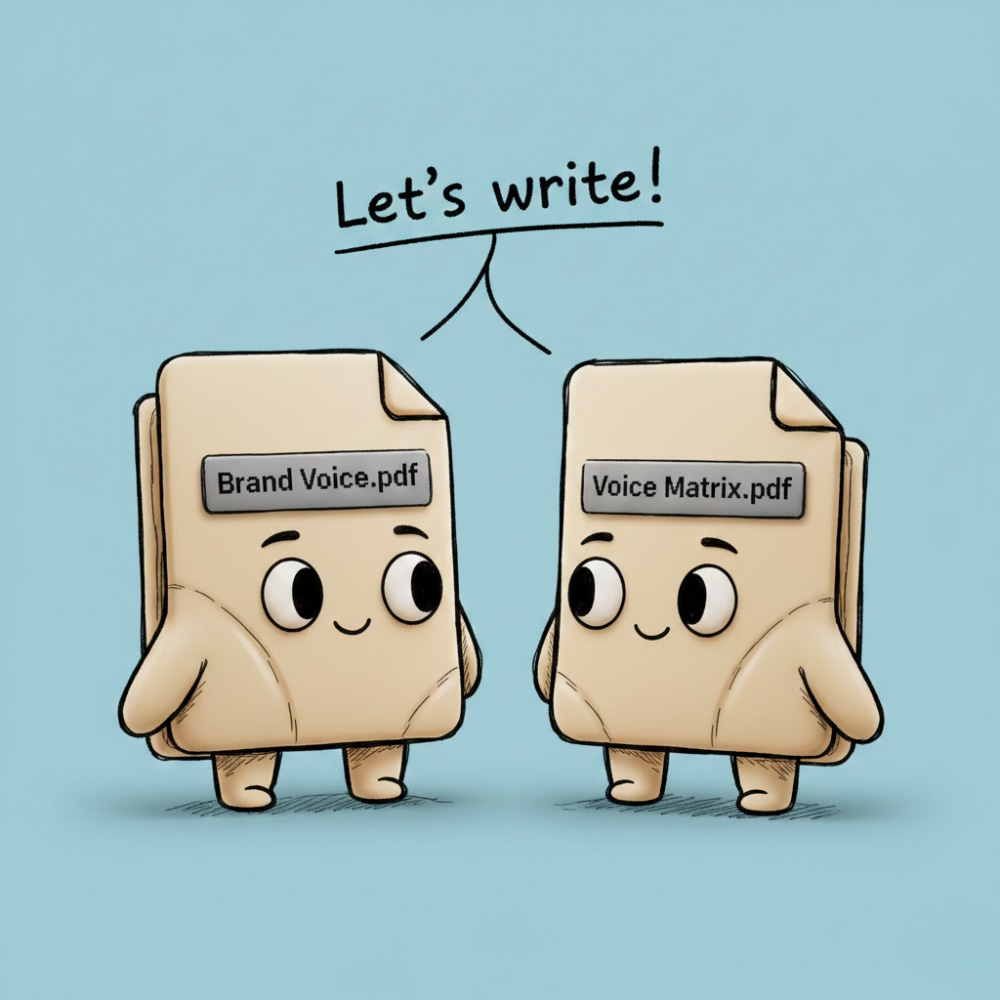
The next step: adding a Voice Matrix as a building block.
Hey, I’m Wilbert. 👋 I teach marketers AI skills that don’t expire and last a lifetime, so you are strategising and shipping better work with AI.
Decode: AI in Marketing 👩🏻💻 is putting AI to work with: inspiration, frameworks, and tools you can apply right away, all built around a community of marketers growing together.If you like this post, please considering sharing it with the world!
Step 2. Voice pillars and the voice matrix.
This is where it stops being abstract. You now translate your three to four personality traits into clear Voice Pillars.
If one of your pillars is Clarity, what does that mean in practice?
Do: short sentences, active voice, conversational language
Don’t: jargon, passive constructions, sentences longer than twenty words
Golden tip: use before-and-after examples. Show how an unclear sentence becomes one that truly fits your brand.
Add this to the same document: Brand Voice (PDF).
Next, create a Voice Matrix. Your “About us” page does not sound the same as a customer service email.
Define the balance per channel:
Formal versus informal
Serious versus playful
This prevents discussions because the boundaries are clear per channel.
Example:
Customer service email: more informal, first-name basis, serious
Internal email: informal, first-name basis, slightly playful
Website: more formal, first-name basis, serious
Company LinkedIn: depends on purpose and audience
Save this as a separate PDF called Voice Matrix.
Step 3. The turbo button.
Your Brand Voice System with AI
This is where it gets truly interesting. Let’s face it: brand voice handbooks are rarely read. But what if your AI reads it instead?
You can now transform your Brand Voice System into an AI-driven Brand Voice System. When set up correctly, it saves hours of work every week.
Practically speaking:
At this point, you have at least these documents:
Brand Voice.pdf
Voice Matrix.pdf
Add your best example texts, each saved as separate PDFs. For example: LinkedIn Post Example.pdf.
You can now train AI tools with your Brand Voice System.

Claude Projects (my recommendation!):
Claude by Anthropic has a powerful feature called Projects. You can upload your entire Brand Voice System and example texts as a knowledge base.
How it works:
Create a project called Our Brand Voice. Upload your documents and start a chat within the project with the instruction:
“Write a LinkedIn post about [topic] in our style.”
Of course, include sufficient context and content.
Claude scans your uploads with every prompt and produces text that is on target in roughly 90 percent of cases.
Step 4. The check. Ogilvy
Your text is ready. You have refined the 80 to 90 percent version into a strong piece. Now what?
A marketer who wants real impact uses AI not only as a concept writer, but also as a strict final editor. Build a fixed review moment into your process.
Ask your tool:
“Evaluate this text based on our Brand Voice System and the writing principles of David Ogilvy. Provide concrete improvement points.”
Personally, I am a fan of Ogilvy. Founder David Ogilvy was a leader in clear, direct writing for decades. His simple yet powerful principles include:
write the way you speak
use short words
never bore your reader
This way, you ensure the text not only sounds like your brand, but also meets timeless standards for persuasive writing.
Step 5. Distributing the Brand Voice System
Make sure new colleagues and your AI tools have immediate access to your Brand Voice System. A Claude Project, GPT, or Gemini Gem can be shared with multiple users across your organization.
Ensure that everyone who writes has access.
Your Brand Voice System is never finished. You expand it with new examples and refine it over time. Those updates should always be reflected in the system.
I can do this for you
Would you like to build an AI-driven Brand Voice System? Get in touch to explore how I can take this off your hands. I will happily go through the steps above for you, so you benefit from this system for years to come.
Visit www.wilbertkramer.nl for more information.
This is very interesting!
That's really useful thank you for writing this